SECTION 04 / PHARMACOKINETIC TELEMETRY

CJC-1295 Pharmacokinetics and Half-Life in Human and Animal Studies

The measured kinetics of a long-acting GHRH analog: a multi-day half-life, a 28-day IGF-1 tail, and the albumin chemistry that produced both.

The CJC-1295 half life, as measured

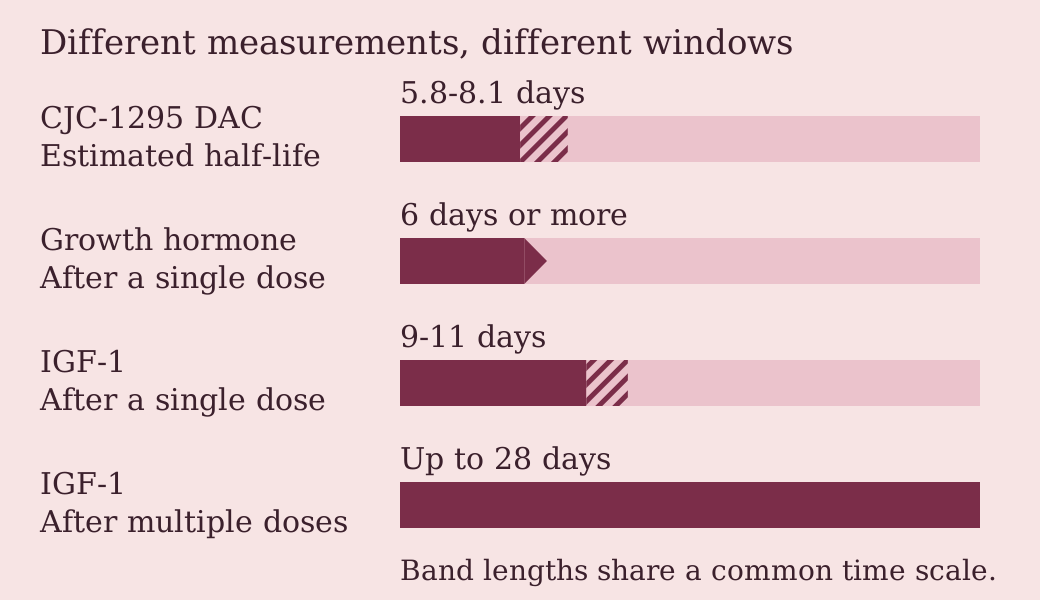
The CJC-1295 half life is the compound's defining number: 5.8-8.1 days in healthy adults, estimated from single and multiple subcutaneous doses in Teichman 2006 [1]. That figure refers to the DAC variant. Around it sits the rest of the human kinetic profile: a single 30 or 60 ug/kg dose raised mean plasma GH 2- to 10-fold for six days or more and IGF-1 1.5- to 3-fold for nine to eleven days; after multiple doses, IGF-1 remained above baseline up to 28 days [1]. The half-life is what makes the multi-day GH elevation and the 28-day IGF-1 tail possible — a single injection that keeps working for the better part of a week.

In a second human study, a single 60 or 90 ug/kg dose raised basal GH about 7.5-fold and IGF-1 about 45% one week after administration, while pulsatile GH secretion was preserved [3]. The kinetics are sustained but not flat; the pulse pattern rides on top of the elevated baseline.

Why the half-life is measured in days

The duration comes from chemistry, not dose size. Native GHRH is cleaved within minutes by dipeptidylpeptidase-IV; the D-Ala-2 substitution blocks that cleavage, and three further substitutions add resistance to deamidation and oxidation [2]. On its own, that protease protection extends the no-DAC peptide modestly. The multi-day half-life belongs to the DAC variant, where the maleimidopropionyl linker covalently binds serum albumin: the peptide travels as part of a ~66-kDa albumin conjugate and is cleared on albumin's timescale rather than the peptide's [2]. In rats, the conjugate produced a 4-fold GH AUC over two hours versus the unconjugated peptide, with peptide detectable in plasma beyond 72 hours — the animal signature of the same long-residence mechanism [2].

Pulsatility preserved under sustained stimulation

A long half-life could, in principle, flatten GH secretion into a continuous infusion. It does not. Ionescu and Frohman 2006 found the frequency and magnitude of pulsatile GH secretion unaltered during continuous stimulation by CJC-1295 [3]. This matters pharmacologically: GH is normally secreted in pulses, and a secretagogue that preserves pulsatility is acting through the physiological release machinery rather than overriding it. The 2009 serum-proteome study reinforced that the axis is genuinely activated, with proteomic shifts correlating linearly with IGF-1 [5].

The animal half-life data

The animal pharmacokinetics anchor the human numbers. The defining rat study screened hGRF(1-29)-albumin bioconjugates and identified CJC-1295 as the long-lasting lead, detectable in plasma beyond 72 hours and stable against dipeptidylpeptidase-IV in vitro [2]. In GHRH-knockout mice, the practical readout of the long half-life was that 2 ug once every 24 hours fully normalized growth, while every-48-to-72-hour dosing was progressively less effective — once-daily was sufficient because the analog's residence covered the interval [4]. The early human GRF(1-29) pharmacokinetic work also used the intravenous route before the subcutaneous studies that defined the DAC profile [1].

The IGF-1 tail outlasts the peptide

One feature of the kinetics is worth isolating: the IGF-1 signal persists longer than the GH signal. A single dose raised GH for six days or more, but IGF-1 stayed elevated for nine to eleven days, and after multiple doses IGF-1 remained above baseline up to 28 days [1]. IGF-1 is the hepatic hormone produced downstream of GH, and its longer tail reflects the integration of a sustained GH signal over time rather than the GH pulse itself [1]. That 28-day IGF-1 elevation is also the basis for the most-cited theoretical safety question: sustained IGF-1 above baseline is the variable epidemiology links to a modestly higher risk of certain cancers [1]. The 2009 serum-proteome study tied the axis activation to measurable protein-level changes that correlated linearly with IGF-1 [5].

How this compares to native GHRH

The entire pharmacokinetic story is a contrast with the unmodified hormone. Native GHRH(1-29) is cleaved by dipeptidylpeptidase-IV within minutes, giving it a half-life far too short for sustained signaling [2]. The four substitutions raise that to a more useful window; the DAC albumin conjugation raises it again, into days [2]. So the CJC-1295 half life is best read as the endpoint of two stacked engineering steps applied to a minutes-scale natural hormone [1][2]. Sermorelin, a short-acting GHRH(1-29) analog, sits near the bottom of that range; the DAC variant of CJC-1295 sits at the top [13]. The approved comparator, tesamorelin, is the GHRH analog that completed clinical development [13].

Where the half-life data stop

The half-life is well characterized; almost nothing downstream of it is. There are no published human studies of steady-state accumulation across long-term dosing, no controlled data on how the 28-day IGF-1 tail behaves under repeated administration over months, and no long-term safety pharmacokinetics [1]. The ConjuChem Phase 2 program that might have generated extended human data was discontinued [7]. The kinetic envelope is a handful of single- and short-multiple-dose studies in volunteers — precise within that window, silent beyond it.